Social Media & Online Behavior
Social Media & Student Life
Social media has become embedded into students’ means of communication, organisation, relationships, and overall daily lives.
Social media is embedded into students’ lives
For many students, social media is inseparable from their day-to-day lives. It can be what they begin their conversations with, where they find announcements for class, where they see their friends post, where they discuss upcoming group projects, or where they arrange their weekend activities. A student may go from talking to a friend, to looking over a class announcement, to watching a video, to discussing an assignment with a classmate, all without thinking anything of it. Social media has become embedded into their environment of communication. As much as it does not necessarily mean students are using it in identical ways, it does mean their boundaries between ‘online’ and ‘student life’ are becoming increasingly blurred.
Maintaining relationships
One obvious benefit of social media is its ability to just stay in contact. They can speak to friends who are in another class, another school, another city, or another country. They can catch up with family members, send them messages and photos, and continue on conversations that they started earlier that day.
A mixed-methods study of 1,003 Filipino college students found that maintaining peer and family relationships was one of the ways that social media fulfilled students’ social needs. Nearly half of the participants discussed the use of social media to maintain peer relationships in particular, which they said was especially useful when face-to-face interaction was compromised in the face of the COVID-19 pandemic (Cleofas et al., 2022).
It is the technology itself which does not create the value of the relationship; it simply allows it to be maintained, if their physical presence is not possible.
Friendships do not stop with the school day
Student friendships do not end with the closing of the school doors. A conversation may continue with a group chat, where friends send each other messages to update one another, make plans, share funny content, and simply ask if the other is doing well. This can allow social media to feel less like an extra activity and more like an extension of their friendships.
A study following young people from ages 10 to 18 found that increased social media usage predicted increased offline time spent with friends, although it was not associated with later developments in social skills. The researchers also highlighted that socially anxious young people may face different challenges (Steinsbekk et al., 2024).
This is useful information, because it complicates the notion that simply being online is necessarily being less social offline; sometimes, the online conversation is simply another means of maintaining the offline relationship.
Group chats have become part of school
For students, social media is not only a means of communicating with friends; it can become part of how they operate school itself. A class group chat can serve as a place to remind everyone of a deadline, discuss a schedule change, ask questions about an assignment, or give directions that someone missed while in class.
The 2022 study of Filipino college students found that participants used Facebook and Messenger groups for communication with teachers, announcements, group activities, and classmates. Some students also described using social media as a means to discuss academics and access information relevant to their studies (Cleofas et al., 2022).
This places an interesting scenario: a student may technically be ‘using social media’ while doing something that is clearly school-related. The platform itself does not dictate what the activity is.
Social media can help with learning
While social media is not a substitute for formal education, it can serve as an alternative source of learning. Students may come across explanations of difficult concepts, educational videos, discussions of current events, study groups, and others discussing and sharing resources.
A 2024 study examining undergraduate students at universities in the Philippines and the Kyrgyz Republic found that students described the use of social media for communication, education, awareness of current events, entertainment, self-expression, business, motivation, and inspiration (Canlas & Perez, 2024).
What is an important distinction, however, is that simply finding information on social media does not necessarily make that information reliable. A student would still have to decide if a source they found is credible, current, and appropriate for their schoolwork. Social media can make it easier to find information, but it does not remove the need to evaluate it.
Not all activities have the same effect
It is tempting to ask if social media is ‘good’ or ‘bad’ for students. However, that question is probably too broad, because different activities can have vastly varying relationships with their student lives. Talking to classmates about a group project is not the same thing as scrolling endlessly through unrelated content; posting about a hobby is not the same thing as using a group chat to organise a school activity.
Research with 700 Filipino university students found that different dimensions of Facebook engagement were associated with a student’s level of academic engagement and involvement in different ways. Self-expression was positively associated with agentic engagement, while overuse was negatively associated with behavioural engagement. The study, therefore, suggests that the way a student uses social media matters, rather than there being a uniform effect of social media use (Datu et al., 2018).
That is a distinction that is easy to overlook: two students may use the same amount of time on social media, but have vastly different experiences, because they are doing completely different things.
It can also become part of their participation
In addition to connecting with their friends and classmates, social media can connect students to communities outside school. They may follow local issues, discover organisations, participate in discussions, share information, or become aware of events happening around them.
The large Filipino college-student study also found that social media could support community engagement and social advocacy, besides communication, identity, education, and relationships (Cleofas et al., 2022).
This means a student’s life can extend beyond their environment of a classroom or campus. A student may come across an issue happening in another part of the country and become interested in it within minutes. This can be useful, but it can also mean that a student is exposed to much more information and opinion than previous generations encountered during an ordinary school day.
Sometimes the boundaries can be blurred
The convenience of social media is, in part, also what can blur the boundaries of different aspects of their lives. A student can finish school, but still receive messages about school; they can be talking to friends while studying, open up an app to read a message about one announcement and end up watching unrelated videos, or intend to answer one message but discover that half-an-hour has passed. This is why we cannot reduce the question of social media use to how much time they spend online. What they are doing matters, who they are talking to matters, and what they are trying to accomplish matters.
Being in touch is not the same as being constantly in contact
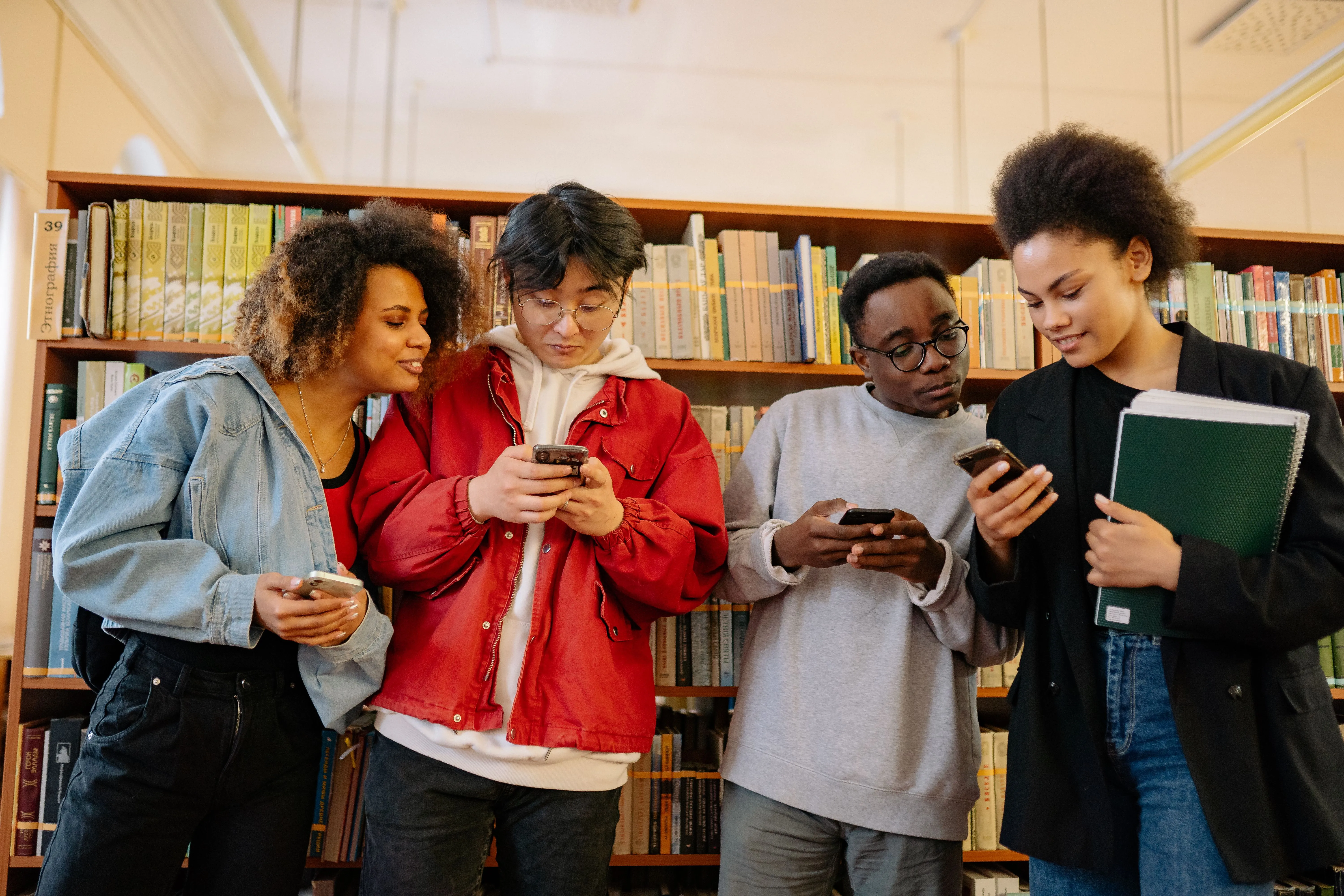
There is also a distinction between being in touch and being constantly in contact. A student may feel expected to respond quickly to their friends or classmates, because they can be reached at any time. Group chats can cause the assumption that everyone has seen an announcement immediately, and a conversation that used to end with the end of school can continue into the evening. This can be beneficial - but it can also make it difficult to feel totally away from other people’s expectations.
A 2024 survey of 384 Filipino college students found that digital stress was associated particularly with social media, online learning platforms, games, and video streaming, while students also reported a strong need for constant phone access (Giray et al., 2024).
Being able to be reached can be useful, but it does not mean that they have to be reached constantly.
Social media has changed how students make plans
Even ordinary plans can now happen through a screen. A group of friends can decide where to eat, organise a birthday, set up a school activity, and decide how everyone is going to get home without having to be in the same place. These are things that seem too ordinary to study, but they represent how embedded social media has become in everyday routines.
The important change is not necessarily that students now communicate with technology; people have always found ways to communicate. It is that communication can now happen continuously, across different places and at almost any time.
What does social media actually contribute to students’ lives?
It contributes another layer.
They can maintain friendships outside their school hours, have communication with classmates, receive announcements, find information, participate in communities, express themselves, and make plans without needing everyone to be physically together.
However, this does not necessarily mean that all aspects of social media use are automatically beneficial. The same platforms can interrupt their studying, create expectations of being in contact, expose them to unreliable information, and make it difficult to separate school, friendships, entertainment, and personal time.
For me, the more useful way to think of social media is not that students should or shouldn’t use it. It is part of how many students live. The more important questions are what they are using it for, how deliberately they’re using it, and whether it is helping them accomplish what they want to.
Social media has become part of students’ lives, and the challenge is learning how to ensure that their lives do not become entirely about social media.
Sources
Cleofas, J. V., Albao, B. T., & Dayrit, J. C. S. (2022). Emerging adulthood uses and gratifications of social media during the COVID-19 pandemic: A mixed methods study among Filipino college students. Emerging Adulthood, 10(6), 1549-1565.
Canlas, I. P., & Perez, M. G. (2024). Undergraduate students' perception of social media use: Opportunities and threats. Bulletin of Science, Technology & Society, 44(1-2).
Datu, J. A. D., Yang, W., Valdez, J. P. M., & Chu, S. K. W. (2018). Is Facebook involvement associated with academic engagement among Filipino university students? A cross-sectional study. Computers & Education, 125, 246-253.
Senekal, J. S., Groenewald, G. R., Wolfaardt, L., Jansen, C., & Williams, K. (2023). Social media and adolescent psychosocial development: A systematic review. South African Journal of Psychology, 53(2), 157-171.
Steinsbekk, S., Bjørklund, O., Valkenburg, P., Nesi, J., & Wichstrøm, L. (2024). The new social landscape: Relationships among social media use, social skills, and offline friendships from age 10-18 years. Computers in Human Behavior, 156, 108235.
Giray, L., Nemeño, J., Braganza, J., Lucero, S. M., & Bacarra, R. (2024). A survey on digital device engagement, digital stress, and coping strategies among college students in the Philippines. International Journal of Adolescence and Youth, 29(1), 2371413. DOI: 10.1080/02673843.2024.2371413.