Social Media & Online Behavior
Online Identity & Self-Presentation
The version of us that appears online may not always be the version of ourselves that people see offline.
We are not always the same person online
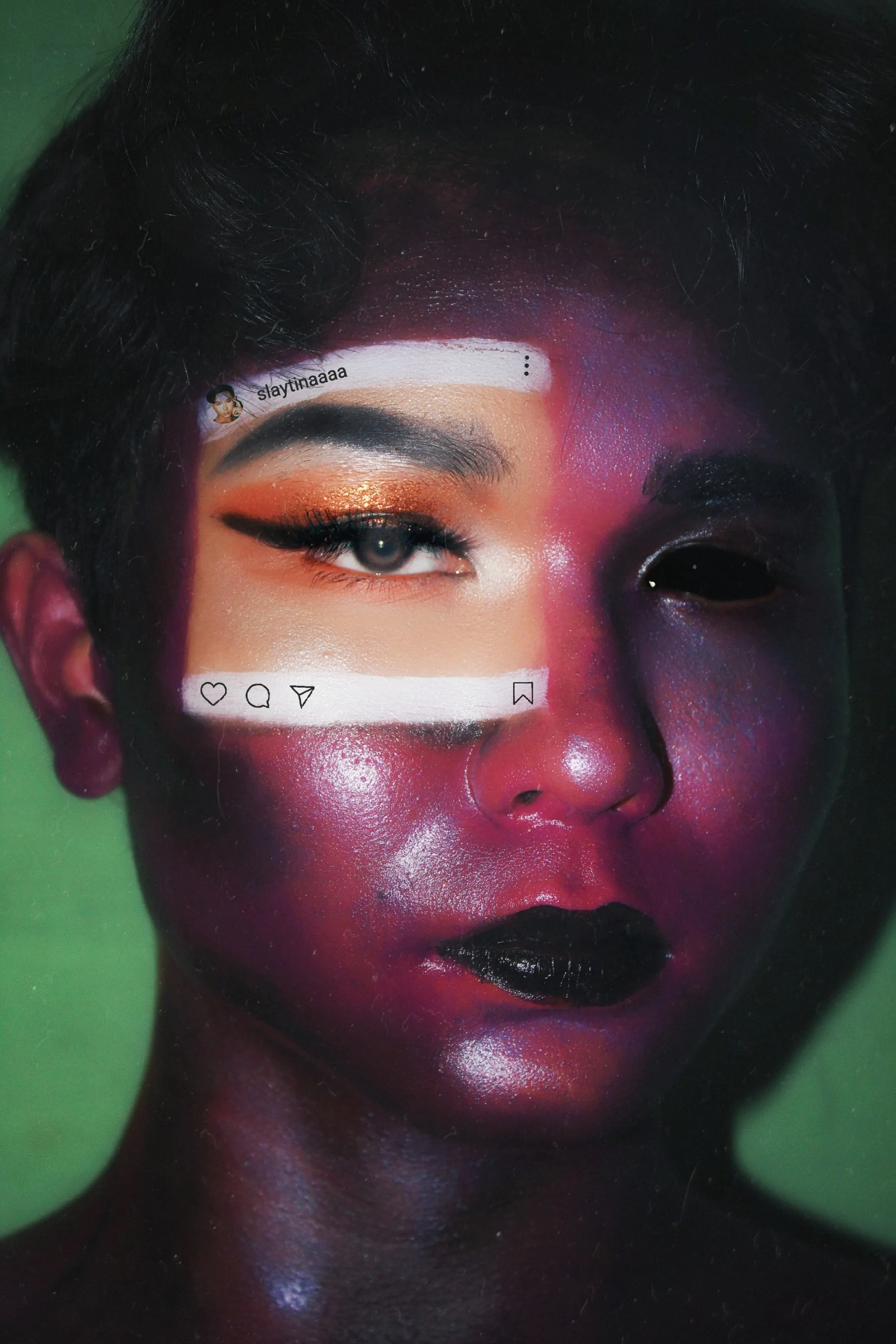
Consider the way one might present themselves on social media. Perhaps their posts show a version of themselves who looks good in the pictures, likes the same music, has a hobby, shares what they agree with, or keeps private parts of their life hidden. None of these options are inherently dishonest.
Humans have always presented different parts of themselves for different audiences. What makes it interesting in the case of social media is that it gives us far more control over what we allow others to see. A profile can become a collection of selected moments, choosing the photograph, caption, username, following and the occasional alternate version of themselves that the person appears in different accounts. It is less a reflection of a person’s entirety than it is an audience-specific version (Schlosser, 2020).
Social media allows us to experiment
This is not always a negative thing. Adolescence is a time of self-discovery, finding values and places one belongs. Social media can become another environment where this process of exploration takes place. A student may find a community about an interest they have never been able to talk about with people nearby, try a different style, talk about an opinion they are in the process of developing, join a community, or create content that reflects another side of themselves that they do not typically reflect in person.
Research into adolescent identity development has found that active participation on social media can be associated with identity exploration. A 2025 systematic review of 32 studies and 19,658 adolescents found that what adolescents did on social media was more strongly associated with identity development than the amount of time they spent there (Avci et al., 2025).
Social media can therefore be considered a space for exploration. The important note is to remember that exploration does not demand that one make every attempt to try something new a permanent part of who one is.
We distinguish between self-expression and performance
The issue becomes more nuanced when one considers the audience. Posting something online is not an exercise of self-expression to one person. One’s post can potentially be seen by friends, classmates, relatives, strangers, or people one has never met, and this changes the way people consider what they are sharing. One may ask oneself if something is good enough to post, if people will understand, if anyone will have a reaction or if it fits the way one presents oneself normally. At some point, self-expression can start to become performance. This does not mean that the well-chosen photograph is fake, but that there is a difference between self-expression and constructing an image for others to respond to.
Research has found that adolescents utilize online self-presentation strategies differently, such as presenting an idealized version of themselves or experimenting with different aspects of their identity, but the evidence also suggests that presenting a version of oneself that does not reflect one’s offline identity can be associated with less clarity about their own self-concept (Avci et al., 2025; Pérez-Torres, 2024).
The audience affects what we share
One strange characteristic of social media is that the audience is often invisible. You may know that your classmates are viewing your story, but you do not necessarily know who, what they think of it or how they interpret it, and this can affect the way one presents themselves. One person might post differently to close friends than to their classmates, have a public account for a wider audience and a personal account where they are more comfortable, or delete something because it did not receive as much attention as expected and became aware of who could see it.
Research into adolescents’ experiences of social media have described how peer feedback can influence self-presentation, and how some create more private spaces where they are able to more freely express themselves without concern for judgment (Hernández-Serrano et al., 2022).
The audience is therefore part of the identity process. One is not only deciding on what one wants to say but what one wants others to know about them.
Likes can become part of the mix
It is easy to say that likes and comments are insignificant, but for some people, they are not. For others, they may barely matter; the effect is not the same for everyone. When a post receives a lot of likes, it may make one feel like people liked what one shared. When it receives almost none, it can be tempting to wonder whether something was wrong with the post, the photograph, or even with oneself, making social media feedback seem more personal than it really is. A number on a screen cannot tell you if you are interesting, attractive, funny, talented, or worth knowing. It only tells you something about how people interacted with one particular piece of content at one particular time. For some people, repeated feedback may affect how they think about themselves.
This is one reason why self-presentation and social comparison often go hand in hand, and why one is both presenting themselves and seeing hundreds of others presenting themselves, and comparing the two.
We rarely compare our average life to someone else’s average life
One who scrolls through social media is not looking at another person’s entire life; they are looking at what they chose to post. The holiday picture would rarely include the boring parts of the trip, the successful student may not post about the hours spent struggling with an assignment, and the confident-looking person may not show the moments when they felt insecure. It is a strange comparison: comparing one’s own average moments to someone else’s selected ones.
Research on adolescent identity development has found associations between social-media comparison and aspects of identity exploration and identity distress. The evidence does not suggest that all comparisons are harmful or that social media is directly responsible for identity problems, but it does explain the importance of the kind of activity taking place online (Avci et al., 2025; Pérez-Torres, 2024).
The problem is not simply that someone else looks happier, but that one may be comparing their entire experience with a very specific piece of another’s.
Being authentic does not mean that you share everything you are
There is a common misconception that authenticity is about sharing everything one thinks, showing every part of one’s life, or refusing to edit anything. Privacy is still important. One can be selective about what one shares and still present a version of oneself that feels real. There is a difference between keeping something a secret and pretending to be someone else.
The systematic review of adolescent identity research has found that more authentic self-presentation was associated with greater self-concept clarity, while idealized or fictitious self-presentation was associated with identity exploration and, in some studies, less clarity about the self. The researchers also caution that most of the evidence is correlational, and cannot establish a simple cause-and-effect relationship (Avci et al., 2025).
That distinction is important. Social media does not necessarily make one less authentic, but it does give more opportunities to choose which parts of oneself one presents, and these choices can intersect with how one understands themselves.
Filipino students are also navigating this issue
This is not only an issue from studies in other countries. A 2025 study of 290 Filipino college students examined the relationship between online self-presentation and their sense of social connectedness. The researchers found that students who reported higher levels of curated online self-presentation, such as presenting multiple selves or preferring online interaction, also tended to report lower levels of social connectedness (Epifanio & Gallegos, 2025). That does not mean that the two behaviors are connected causally, but it does raise an interesting question: if a person becomes very focused on managing their online appearance, can the version they present eventually become more important than the person they actually are around others? There is no simple answer, but it is a useful question to ask.
You do not have to maintain one version of yourself everywhere
It can be tempting to think that consistency is the goal: the same profile picture, the same personality, the same interests, the same opinions, the same way of speaking. Real people are rarely that consistent. You may be serious in class, loud with your closest friends, quiet around strangers, and completely separate when you are alone. None of these versions necessarily negate the other. The same thing could be happening online. Different accounts, communities and audiences can bring out different sides of a person. That does not necessarily mean that someone is being fake, but it can sometimes mean that different environments make different parts of us more visible. The important question is whether you still recognize yourself in what you are presenting.
What happens when the profile becomes the person?
There is a point where the self-presentation can become fatiguing. You start thinking about whether your posts fit your image, worry about changing something because people might notice, compare appearance with others, delete things that do not receive enough attention, and begin making choices based on what you think your audience expects instead of what you actually like. At that point, social media can stop being a place where you express yourself and start being a place where you constantly manage yourself. That distinction is worth noting.
A profile is something that you create.
It is not meant to become the thing that one decides who they are.
Your online identity is still part of your identity
There is no clean separation between an “online you” and a “real you”. The person who is posting, commenting, joking, sharing and interacting online is still the same person who goes to school, talks to friends, and goes offline. But the online environment gives that person more tools: you can edit, delete, choose an audience, present an image until it feels natural, and receive feedback from people you know and people you have never met. This makes the online identity something worth thinking about rather than dismissing as fake.
For me, the useful question is not whether the version of ourselves online is entirely real, but whether the version we are presenting is still one that we recognize. Social media gives us the ability to choose what other people see, and it is worth remembering that we are also choosing what we see when we look back at ourselves.
Sources
Avci, H., Baams, L., & Kretschmer, T. (2025). A systematic review of social media use and adolescent identity development. Adolescent Research Review, 10, 219–236.
Epifanio, L. J., & Gallegos, I. N. (2025). Investigating online self-presentation and social connectedness among Filipino college students. Discourse and Communication for Sustainable Education, 16(2), 44–56.
Pérez-Torres, V. (2024). Social media: A digital social mirror for identity development during adolescence. Current Psychology, 43, 22170–22180.
Schlosser, A. E. (2020). Self-disclosure versus self-presentation on social media. Current Opinion in Psychology, 31, 1–6.
Yang, C. C., & Bradford Brown, B. (2016). Online self-presentation on Facebook and self-development during the college transition. Journal of Youth and Adolescence, 45, 402–416.
Hernández-Serrano, M., Jones, B., Renés-Arellano, P., & Campos Ortuño, R. (2022). Analysis of digital self-presentation practices and profiles of Spanish adolescents on Instagram and TikTok. Journal of New Approaches in Educational Research, 11(1), 49–63.